Journal · July 2026
How to reupholster a dining chair: a step-by-step guide from professional upholsterers.
To reupholster a dining chair with a drop-in seat: unscrew the seat, strip the old cover and keep it as a template, replace tired foam, cut new fabric with an 8-10 cm margin, staple from the centre of each side outwards, pleat the corners, and finish with a dust cloth. Budget about half a metre of fabric and under an hour per chair. This is the exact method we use on hundreds of dining chairs a year in our Stalybridge workshop, upholstering since 1978.
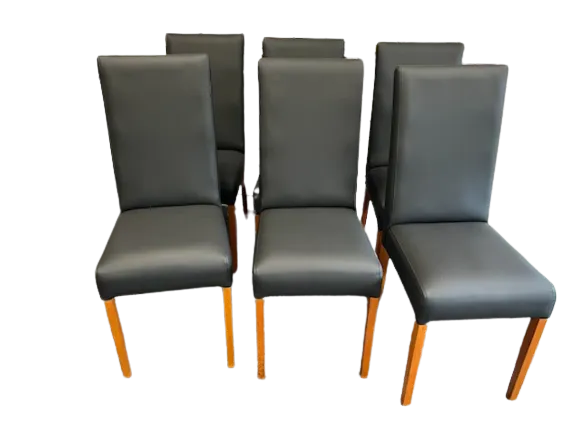
Before you start: check what kind of chair you have
This guide covers the drop-in seat: a padded board that lifts out of the chair frame when you remove a few screws underneath. Around four in five dining chairs are built this way, and it is genuinely a beginner-friendly job. If the upholstery is fixed to the chair frame itself, or the chair has a padded back, sprung seat or deep buttoning, the strip-back and re-build is a workshop job; see our dining chair reupholstery service for what that involves.
Tools and materials
- Heavy-duty staple gun with 8-10 mm staples. Hand tackers work; electric guns save your wrist on a set of six.
- Tack lifter or flat-head screwdriver plus pincers, for removing the old staples.
- Fabric scissors that actually cut. Upholstery weaves blunt craft scissors quickly.
- Upholstery-weight fabric, about 0.5 m per seat at 140 cm width. Look for a rub count (Martindale) of 20,000+ for dining use.
- High-resilience foam and polyester wadding if the pad has collapsed. We stock and cut foam to size if you only need the materials; see foam cut to size.
- Black bottoming cloth to close the underside neatly.
The 7 steps
- Unscrew the seat from the frame. Turn the chair upside down and remove the screws holding the drop-in seat pad to the frame. Keep the screws somewhere safe. If the seat is glued or upholstered onto the frame itself, stop here: that is a fully upholstered chair and a different job.
- Strip the old cover. Pry out the old staples or tacks with a tack lifter or flat-head screwdriver and pull the staples with pliers. Keep the old cover in one piece: it is your cutting template for the new fabric.
- Check the pad underneath. Inspect the foam or traditional stuffing and the webbing or plywood base. If the foam has collapsed, gone crumbly or stained, replace it with new high-resilience foam cut to the seat shape, topped with a layer of polyester wadding so the cover slides on smoothly and the foam does not abrade.
- Cut the new fabric. Lay the old cover flat on the reverse of the new fabric, square to the weave, and cut around it. If you have no usable old cover, cut to the seat board size plus 8 to 10 cm on every side for pulling and stapling. Centre any pattern on the seat before cutting.
- Staple from the centres out. Place the fabric face down, the pad centred on top. Pull the fabric to the underside and put one staple in the centre of each side, pulling to an even tension. Work outwards from each centre towards the corners, alternating sides so the tension stays even and the weave stays straight.
- Fold and staple the corners. Pull the corner point in first, then fold each side over it into a neat hospital-corner pleat and staple. Trim excess bulk out of the fold so the seat still drops into its rebate in the chair frame.
- Fit a dust cloth and refit the seat. Staple a black bottoming cloth over the underside to cover the raw edges, then screw the seat back into the frame through the original holes.
The mistakes we correct most often
When DIY seats come into the workshop for a re-do, it is nearly always one of four things: fabric stapled corner-first so the weave sits skewed; too little pulling tension, so the cover bags within a month; foam re-used when it had already collapsed, so the new cover telegraphs every lump; or so many layers of old fabric left on that the seat no longer drops into its rebate. Strip back, replace tired foam, staple centres-out under even tension, and none of those happen.
UK fire safety: the part most guides skip
Upholstered furniture in UK homes is covered by the Furniture and Furnishings (Fire) (Safety) Regulations 1988. In practice: buy fabric sold specifically as upholstery fabric (match-test compliant), or fit an FR barrier cloth between the foam and a non-compliant fabric, and always use foam that is combustion modified, which any reputable UK foam supplier cuts as standard. If you plan to sell the finished chair, the regulations apply in full and the fabric needs the right certification. For commercial settings such as pubs and restaurants the standard is stricter still (BS 5852 Crib 5), which is workshop territory; see our contract seating service.
DIY vs professional: honest numbers
Doing it yourself, expect £20 to £40 per chair in materials (fabric, foam if needed, staples, bottoming cloth) and about an hour per seat once you have the knack. Our workshop price is £35 to £65 per drop-in seat plus fabric and VAT, which includes stripping back, new foam and wadding where needed, pattern-matching across the set and the fire-safety compliance above. Fully upholstered dining chairs are £95 to £145 each plus fabric and VAT. Where the maths tips towards us: sets of six or more (pattern matching across a set is where DIY jobs go visibly wrong), fully upholstered or button-back chairs, and anything antique or sentimental. Current ranges for every service are on our pricing page.
Common questions
- How much fabric do I need to reupholster a dining chair?
- A standard drop-in dining seat takes about half a metre of 140 cm wide upholstery fabric. One metre usually covers two seats. Patterned fabric needs more so the motif sits centred on every chair in the set.
- Can I reupholster over the old fabric?
- One clean, thin existing layer is sometimes acceptable, but stripping back is always better. Layers build up on the edges, stop the seat dropping back into its frame, and hide collapsed foam or perished webbing that should be replaced.
- What staples should I use for a dining chair seat?
- A heavy-duty staple gun with 8 to 10 mm staples suits most drop-in seats. Longer staples can punch through thin seat boards; shorter ones pull out under tension.
- Does the fabric need to be fire retardant in the UK?
- Upholstered furniture in UK homes falls under the Furniture and Furnishings (Fire) (Safety) Regulations 1988. Fabric sold as upholstery fabric in the UK is normally match-test compliant or used over an FR barrier cloth. If you are recovering furniture to sell, the regulations apply in full, so use certified fabric.
- How much does professional dining chair reupholstery cost?
- Our workshop charges from £35 to £65 per drop-in seat plus fabric and VAT, including new foam where needed. Fully upholstered dining chairs run £95 to £145 each plus fabric and VAT. A set of six drop-in seats is usually done within a week.
Unsure how it will look?
Send photos, rough sizes and the style or fabric you have in mind. We will send a free quote with example looks so you can decide with confidence -- no obligation.